
Introduction
If you’ve come across AGAB Meaning online and wondered what it stands for, you’re not alone. The abbreviation is widely used in discussions about gender, identity, healthcare, and social media, making it helpful to understand its meaning and context. Knowing AGAB Meaning can make conversations easier to follow and prevent misunderstandings when reading articles, forums, or online posts.
Whether you’ve seen it on TikTok, Reddit, X, Instagram, or other platforms, this guide explains everything in simple, beginner-friendly language. We’ll cover the full form, how it’s used, why it’s important, and common examples you’ll encounter online. At BoringValve.com, we’ve created this easy-to-understand guide so anyone can learn AGAB Meaning and use the term confidently in 2026.
This guide breaks down exactly what AGAB stands for, where it came from, how people use it in real conversations, and why it matters in 2026’s digital communication landscape. Whether you saw it in a comment section, a bio, or a group chat and quietly opened a new tab to search it, this article will clear things up in plain, simple language.
What Does AGAB Stand For? 🤔
AGAB stands for Assigned Gender At Birth. It refers to the gender a person is labeled with by a doctor or on a birth certificate, usually based on physical anatomy observed at the time of birth.
This label is typically recorded as either male or female. The term became common because it makes a clear distinction between:
- The gender someone was assigned at birth
- The gender someone identifies as later in life
These two things do not always match, and that is exactly why the phrase exists. It gives people a precise, respectful way to talk about the topic without assuming that a birth record automatically defines someone’s true identity.
Understanding AGAB in Daily Chats 💬

In everyday texting and online conversations, AGAB usually shows up when someone is discussing gender identity, medical history, or personal experience with being transgender or nonbinary. It is not a joke term or random slang, it is closer to a functional shorthand used in serious or supportive conversations.
A few common situations where you might see it used:
- Someone explaining their medical history to a doctor
- A friend supporting another friend through their identity journey
- Educational content or advocacy posts about transgender issues
- Community discussions on Reddit, Discord, or X
Because it is tied to identity, tone matters a lot. It is generally used thoughtfully rather than casually thrown around like typical internet slang.
Origin of AGAB 📜
The exact moment AGAB first appeared online is hard to pin down, since it grew organically inside LGBTQ+ communities rather than being coined by one specific person or brand. What is clear is that the phrase Assigned Gender At Birth gained traction as advocacy groups, healthcare providers, and online educators looked for more accurate language than older, less precise terms.
Instead of saying someone was born a boy or born a girl, which implies gender is fixed from birth, AGAB acknowledges that a label was assigned, and that the label does not always match a person’s actual identity. This small wording shift carries a lot of meaning, and it is part of why the term spread so widely in advocacy and healthcare spaces.
Language experts and community writers often point out that this kind of shift is not just about political correctness. It is about linguistic accuracy. Birth certificates record a physical observation made by someone else, usually a doctor, in the first moments after birth. That observation is not the same as a lived, internal sense of identity that develops over a person’s lifetime. By naming the process (assignment) rather than treating it as a permanent fact, the term AGAB gives people a more honest starting point for conversations about gender.
Healthcare settings were among the earliest formal adopters. Doctors, nurses, and patient intake forms began separating sex assigned at birth from gender identity as medical understanding of transgender health improved. This distinction helps providers deliver safer, more accurate care, since certain screenings or health risks are tied to biological factors present at birth rather than to how a patient currently identifies.
Timeline of AGAB Usage ⏳

| Period | How AGAB Was Used |
| Early 2010s | Mostly used within niche transgender and nonbinary online forums |
| Mid 2010s | Adopted more widely in LGBTQ+ advocacy and healthcare documentation |
| Late 2010s | Appeared in mainstream education materials, university guides, and diversity training |
| Early 2020s | Spread onto major platforms like TikTok, Reddit, and X during broader identity discussions |
| 2026 | Recognized in reference resources like Collins Dictionary and used casually across mainstream social platforms |
This steady climb shows how a term that started in specific communities can eventually enter everyday digital vocabulary.
Why People Use AGAB Online 🌐
There are a few clear reasons this term keeps showing up in conversations:
- Precision: it separates the idea of a birth label from actual identity, which avoids confusion.
- Respect: it is considered a more accurate and inclusive way to talk about gender than older phrasing.
- Efficiency: it condenses a longer explanation into one short, recognizable acronym.
- Community connection: using shared vocabulary helps people feel understood within LGBTQ+ and ally spaces.
- Medical context: healthcare providers sometimes need to reference a patient’s AGAB for accurate treatment, separate from their current identity.
In short, people use AGAB because it says something specific that other, more casual words cannot say as clearly.
There is also a generational element to this shift. Younger internet users, especially those active on platforms built around identity and self-expression, tend to value language that reflects nuance over simplicity. A single word like boy or girl flattens a much more complex reality, while AGAB leaves room for that complexity without requiring a long explanation every time. This is part of why the term spread so quickly once it reached mainstream platforms instead of staying inside smaller advocacy circles.
Another factor is consistency across contexts. The same term works whether someone is filling out a medical form, writing a personal essay, or replying to a comment on social media. That versatility is rare for identity-related vocabulary, and it is one reason AGAB has stuck around instead of fading like many short-lived internet phrases.
Examples of AGAB in Sentences 📝
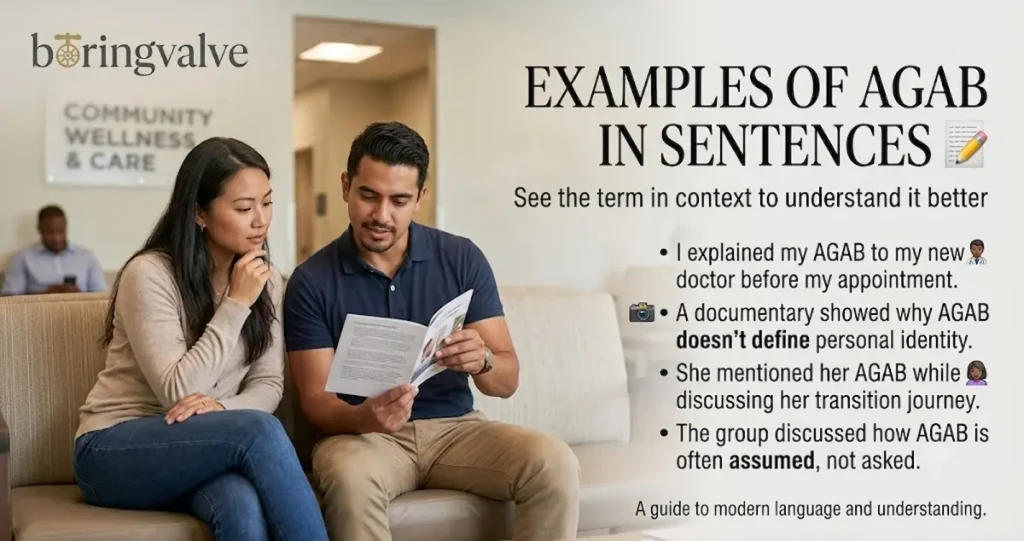
Seeing the term in context makes it much easier to understand. Here are some natural examples:
- I had to explain my AGAB to the new doctor before my appointment.
- The documentary explained why AGAB does not define someone’s real identity.
- She mentioned her AGAB while talking about her transition journey.
- Understanding someone’s AGAB isn’t the same as understanding who they are today.
- The support group discussed how AGAB is often assumed instead of asked.
Notice that in every example, AGAB refers strictly to the birth label, never to a person’s current gender identity.
Common Misconceptions About AGAB ❌
Because AGAB is still a fairly modern term, a few misunderstandings pop up often:
| Misconception | Reality |
| AGAB and gender identity are the same thing | They are different. AGAB is the birth label, gender identity is how someone actually identifies |
| AGAB is only relevant to transgender people | It can come up in medical, educational, or general identity discussions too |
| Using AGAB is automatically disrespectful | It is a neutral, factual term when used with proper context and tone |
| AGAB always needs to be shared | A person’s AGAB is personal information, not something owed to others |
| AGAB and AMAB or AFAB mean the same thing | AGAB is the general term, while AMAB (assigned male at birth) and AFAB (assigned female at birth) are more specific versions |
Read More : 200+ Funny Under the Sea Puns and Jokes for Ocean Lovers
Clearing up these points helps avoid awkward or hurtful misunderstandings in everyday conversation.
How to Use AGAB Correctly ✅
Since this term relates to personal identity, using it properly matters more than with typical internet slang. Here are some simple guidelines:
- Use it as a noun referring to the birth-assigned label, not as a description of who someone is now.
- Avoid using it to define, label, or out someone without their consent.
- Use it in supportive, educational, or medical contexts rather than as a joke.
- Pair it with correct related terms like AMAB or AFAB when more specific detail is needed.
- When in doubt, let the person themselves guide how much of their AGAB they want to share.
Getting the tone right shows respect and prevents the term from being used in a way that feels reductive or hurtful.
AGAB in Social Media Trends 📱
Social platforms have played a huge role in bringing AGAB into mainstream awareness. On TikTok, creators use it in educational videos explaining gender identity basics. On Reddit, it shows up frequently in transgender and nonbinary community threads where people share personal experiences. On X, it often appears in advocacy posts, news discussions, or personal storytelling threads.
Discord communities built around LGBTQ+ support also use AGAB regularly, especially in channels dedicated to medical questions or transition experiences. As more creators produce content around identity and inclusion, terms like AGAB continue moving from niche spaces into broader digital culture.
Hashtags built around gender identity education frequently include AGAB as a searchable keyword, which helps people find explainer videos, personal stories, and community resources more easily. Comment sections under these posts often become mini glossaries themselves, with users clarifying the term for newcomers who are seeing it for the first time. This organic, peer-to-peer explanation is part of what makes social platforms such an effective place for terminology like AGAB to spread and stay accurate, rather than getting diluted into a vague catch-all phrase.
Podcasts and YouTube creators focused on LGBTQ+ topics have also helped standardize how the term is used. Instead of every creator defining it slightly differently, repeated exposure across multiple platforms has created a fairly consistent, shared understanding of what AGAB means and how it should be used respectfully.
Global Recognition of AGAB 🌍
AGAB has moved beyond internet forums into more formal recognition. Reference sources like Collins English Dictionary now define the term, which signals that it has entered mainstream English usage rather than staying confined to internet slang. Universities, healthcare organizations, and diversity training programs across multiple countries also use the phrase in official materials.
This kind of recognition matters because it shows the term is not a passing trend. It reflects a broader, ongoing shift in how language adapts to represent identity more accurately across cultures and countries.
Different regions have adopted the term at different speeds. In North America and parts of Western Europe, AGAB is now commonly used in university guides, workplace diversity training, and public health resources. In other regions, the concept exists but is expressed through locally translated phrases rather than the English acronym itself. Even so, the underlying idea, separating a birth-assigned label from a person’s actual identity, appears in gender identity discussions worldwide, even when the exact wording changes.
This global spread also shows up in academic research. Sociolinguists studying online communication have noted that acronyms tied to identity, including AGAB, tend to move from small community forums into mainstream dictionaries faster than typical slang. That accelerated path happens because these terms fill a real communication gap rather than simply adding flair to casual conversation.
AGAB Variations and Related Slang 🔄
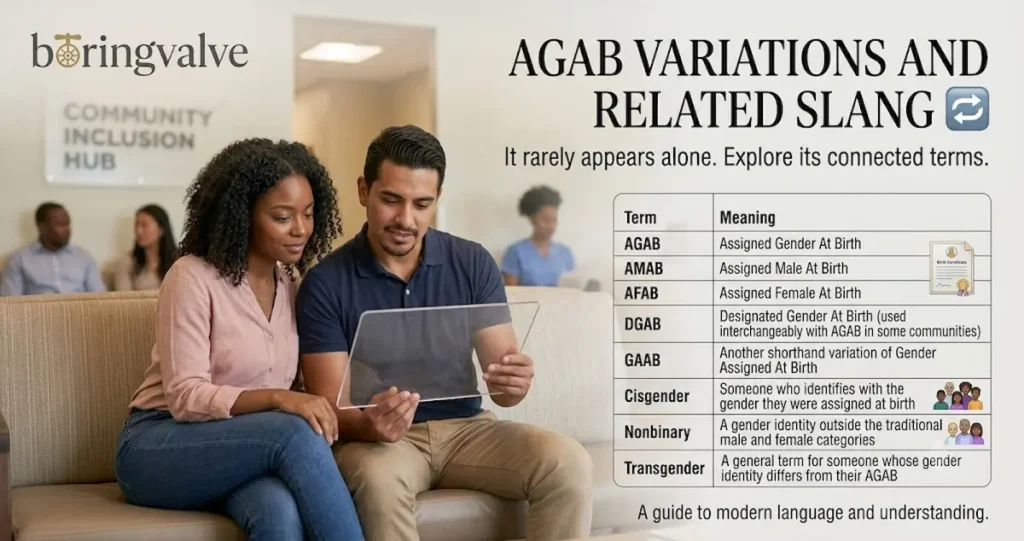
AGAB rarely appears alone. It is often used alongside a small family of related terms that build on the same idea.
| Term | Meaning |
| AGAB | Assigned Gender At Birth |
| AMAB | Assigned Male At Birth |
| AFAB | Assigned Female At Birth |
| DGAB | Designated Gender At Birth (used interchangeably with AGAB in some communities) |
| GAAB | Another shorthand variation of Gender Assigned At Birth |
| Cisgender | Someone who identifies with the gender they were assigned at birth |
| Nonbinary | A gender identity outside the traditional male and female categories |
| Transgender | A general term for someone whose gender identity differs from their AGAB |
Knowing these related terms makes it much easier to follow broader conversations about gender identity online.
Table of AGAB Usage Examples 📊
| Context | Example Sentence | Purpose |
| Medical | I explained my AGAB during my checkup. | Clarifying medical history |
| Social Media | This video breaks down what AGAB actually means. | Education and awareness |
| Personal Conversation | My AGAB doesn’t reflect how I identify now. | Sharing personal identity |
| Advocacy | Understanding AGAB helps reduce assumptions about gender. | Promoting respectful language |
| Casual Support | It’s okay if you’re not ready to talk about your AGAB yet. | Offering emotional support |
This table shows how the same term adapts smoothly across very different types of conversations.
Why AGAB Is Important in Digital Communication 🗨️
Language shapes how people understand each other, especially online where tone and context can easily get lost. AGAB gives people a precise, neutral way to talk about a sensitive topic without making assumptions.
It matters because:
- It separates a birth label from a person’s actual identity, reducing confusion.
- It supports clearer, more respectful conversations in medical and social settings.
- It reflects how digital language evolves to represent people more accurately.
- It helps allies and communities communicate with more empathy and less guesswork.
As online conversations about identity continue to grow, having accurate vocabulary like AGAB makes those conversations easier and more respectful for everyone involved.
For allies who want to be supportive but are not sure what language to use, learning terms like AGAB removes a lot of guesswork. It replaces vague or outdated phrasing with something specific and widely understood, which lowers the chance of accidentally causing offense. For people within transgender and nonbinary communities, having this shared vocabulary means less time spent explaining basic concepts and more time spent on the actual conversation at hand.
This is also why terminology like AGAB tends to show up in style guides used by journalists and content creators covering identity topics. Clear, agreed-upon language helps prevent misreporting and keeps coverage respectful, which matters as more mainstream outlets publish stories involving transgender and nonbinary individuals. In that sense, AGAB is not just internet vocabulary, it has become part of a broader movement toward more precise and considerate public communication.
FAQs
What is the full meaning of AGAB?
AGAB stands for Assigned Gender At Birth.
Is AGAB offensive?
No, AGAB is a neutral term when used respectfully and in proper context.
Can adults use AGAB?
Yes, adults use AGAB regularly in medical, social, and advocacy conversations.
How to pronounce AGAB?
It is typically pronounced by saying each letter separately, as A-G-A-B.
Where can I use AGAB?
Use AGAB in respectful conversations about identity, healthcare, or education, not as casual slang or a joke.
Conclusion
AGAB, short for Assigned Gender At Birth, is far more than a random internet acronym. It represents a meaningful shift in how people talk about gender identity with clarity and respect. From its roots in LGBTQ+ advocacy spaces to its presence in dictionaries and mainstream social media, the term has earned a real place in modern digital vocabulary.
Understanding what AGAB means, along with related terms like AMAB and AFAB, helps you navigate online conversations more confidently and respectfully. As language keeps evolving alongside culture, staying informed about terms like this makes you a more thoughtful participant in today’s digital world.
