
AIM Meaning is one of the most searched terms online because it has multiple meanings depending on the context. Whether you see it in text messages, social media, gaming, education, or everyday conversations, understanding AIM Meaning can help you interpret messages correctly.
In most cases, AIM refers to a goal or objective, but it can also stand for popular abbreviations such as AOL Instant Messenger or have specific meanings in different industries. Many users search for AIM Meaning to understand how it’s used in chat, online communication, and real-life situations. At BoringValve.com, we explain AIM Meaning, its common uses, examples, and different interpretations in this updated 2026 guide.
In this guide, you will learn the complete meaning of aim, its origin, why it matters in real life, its different types, and how it compares to a goal. We will also look at practical examples so you can apply the concept immediately.
What is Aim? 🤔
In the simplest terms, an aim is a purpose, target, or intention that a person or organization wants to achieve. It answers the basic question: what are you trying to accomplish?
The word aim can function as both a noun and a verb.
- As a noun, it refers to the desired outcome or objective. Example: Her aim was to become a doctor.
- As a verb, it means to direct effort toward something or to point at a target. Example: She aims to finish her project by Friday.
Aim is closely related to words like goal, objective, mission, and intention, though each carries a slightly different shade of meaning. An aim usually reflects the broad direction you want to move in, while more specific and measurable steps come later through planning.
In education, an aim often describes the general purpose behind a lesson, project, or experiment. In business, it describes the intended result of a strategy. In everyday speech, it simply describes what someone hopes to do or become.
Origin of Aim 📜
The word aim has an interesting linguistic journey. It comes from the Middle English word aimen, which was borrowed from the Anglo French terms aesmer and esmer. These, in turn, trace back to the Old French aesmer, derived from the Vulgar Latin adaestimare, a combination of the Latin prefix ad and aestimare, meaning to estimate or assess.
Originally, the word carried a sense of calculating or judging distance, which is why it was closely tied to archery and shooting. To aim literally meant to estimate the direction needed to hit a target accurately. Over centuries, the meaning expanded beyond physical targeting to include mental and emotional direction, such as ambitions, life goals, and personal intentions.
This evolution explains why aim still carries a dual sense today. It can describe the physical act of pointing something at a target, such as aiming a camera or a weapon, and it can describe the abstract pursuit of a purpose in life, career, or study.
Why Aim is Important in Life 🌟
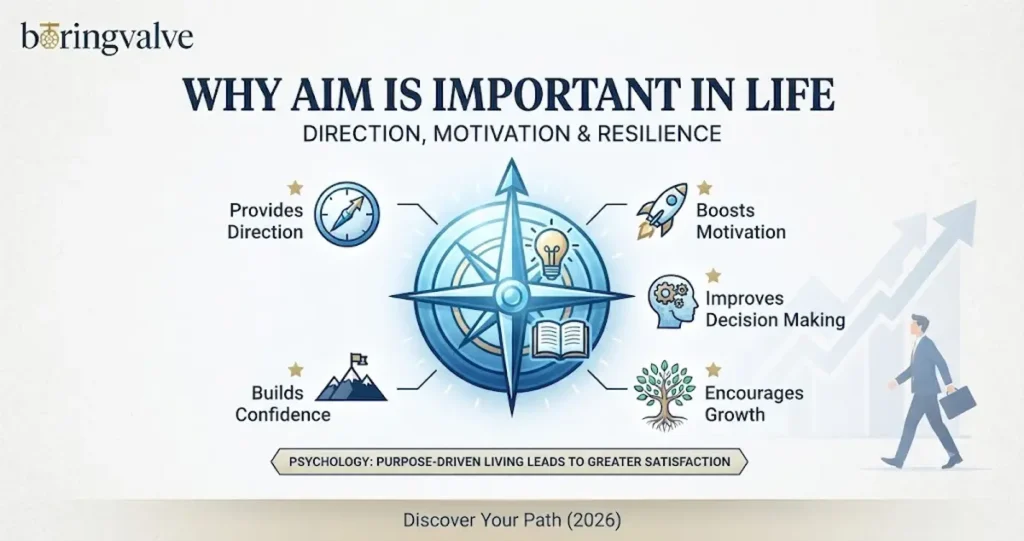
Having a clear aim gives structure and direction to everything you do. Without one, effort can feel scattered and unproductive. Here is why setting an aim matters so much.
- Provides direction: An aim acts like a compass, helping you decide which actions matter and which do not.
- Boosts motivation: When you know what you are working toward, staying consistent becomes easier.
- Improves decision making: A defined aim helps filter choices, so you spend time on things aligned with your purpose.
- Builds confidence: Achieving small milestones tied to a larger aim strengthens self-belief.
- Encourages growth: An aim pushes you to learn new skills and step outside your comfort zone.
Psychologists often note that people who define a clear sense of purpose tend to experience greater satisfaction and resilience, since a defined aim reduces uncertainty and gives daily actions meaning.
Types of Aim 🎯

Aims can be categorized in several ways depending on the time frame and area of life they apply to.
1. Short-Term Aim
A short-term aim is something you plan to achieve within a limited period, usually days, weeks, or a few months. These aims act as stepping stones toward bigger ambitions.
Example: Completing an online course within one month or saving a fixed amount every week.
2. Long-Term Aim
A long-term aim spans a much larger timeframe, often years. It usually requires consistent effort, patience, and multiple short-term aims working together.
Example: Building a successful career in engineering or achieving financial independence by a certain age.
3. Personal Aim
A personal aim relates to individual growth, health, relationships, or self-improvement rather than professional achievement.
Example: Improving physical fitness, learning a new language, or strengthening family bonds.
4. Professional Aim
A professional aim focuses on career development, workplace achievement, or business success.
Example: Earning a promotion, launching a startup, or mastering a technical skill required at work.
| Type of Aim | Time Frame | Focus Area | Example |
| Short-Term Aim | Days to months | Immediate tasks | Finishing a project on time |
| Long-Term Aim | Years | Life direction | Becoming a certified professional |
| Personal Aim | Ongoing | Self-growth | Reading one book every month |
| Professional Aim | Months to years | Career | Getting promoted to a senior role |
Examples of Aim in Real Life 💬
Seeing aim used in real situations makes the concept easier to understand. Here are some everyday examples.
- A student’s aim is to score above ninety percent in final exams.
- A company’s aim is to expand into three new markets this year.
- An athlete’s aim is to qualify for the national championship.
- A writer’s aim is to finish a novel within twelve months.
- A parent’s aim is to raise confident and responsible children.
- A researcher’s aim is to find a solution to a specific medical problem.
These examples show that an aim can apply to almost any context, from academics and sports to business and family life.
How to Set a Strong Aim 🧠
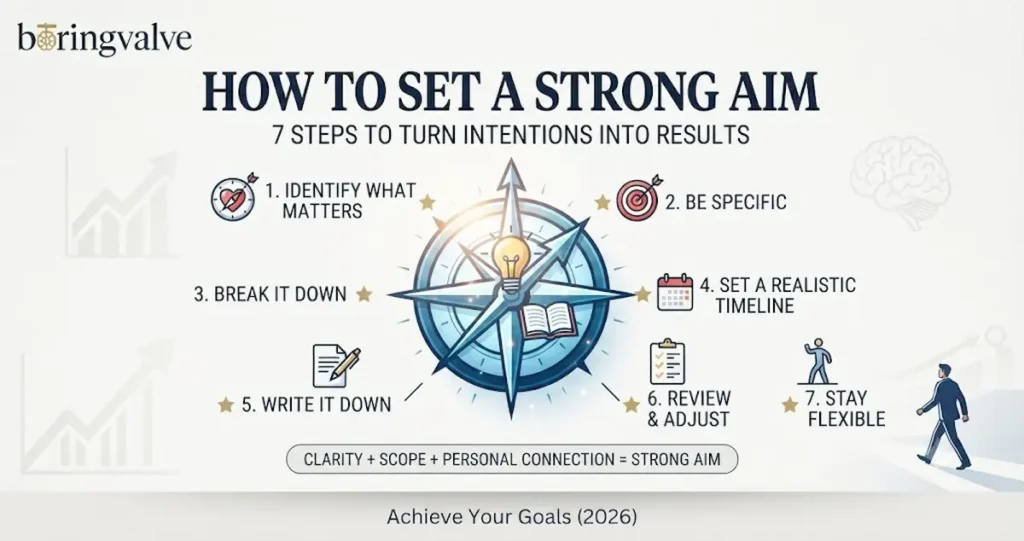
Not every aim leads to results. A weak or vague aim rarely translates into action. Follow these steps to set an aim that actually works.
- Identify what truly matters to you rather than copying someone else’s ambition.
- Make the aim specific enough that you know exactly what success looks like.
- Break the aim into smaller short-term aims or milestones.
- Set a realistic time frame so the aim does not feel overwhelming.
- Write it down, since documented intentions are more likely to be followed.
- Review progress regularly and adjust the approach if needed.
- Stay flexible, because circumstances change and rigid aims can become discouraging.
A strong aim usually combines clarity, realistic scope, and a genuine personal connection to the outcome.
Read More : ABT Meaning Explained: Chat, Text, Snapchat & Social Media (2026)
Common Mistakes While Choosing an Aim ❌
Many people struggle to achieve their aims simply because of avoidable errors in how the aim was framed. Watch out for these common mistakes.
- Being too vague: Saying I want to be successful does not describe what success actually looks like.
- Copying others’ ambitions: Choosing an aim just because someone else has it rarely sustains motivation.
- Ignoring available resources: Setting an aim without considering time, money, or skill can lead to frustration.
- No clear timeline: Without a deadline, an aim can drift indefinitely.
- Fear of failure: Avoiding ambitious aims out of fear limits potential growth.
- Lack of flexibility: Refusing to adjust an aim when circumstances change can cause unnecessary stress.
Recognizing these pitfalls early helps in building aims that are practical and achievable.
Aim in Education 🎓
In academic settings, the word aim frequently appears in lesson plans, research papers, and project reports. A teaching aim describes what a lesson intends to accomplish, such as helping students understand a scientific concept or develop a particular skill.
In research, the aim of a study is usually stated clearly at the beginning of a paper. It explains the purpose behind the research and sets expectations for what the findings will address. A well-written aim in an academic context is concise, specific, and directly connected to the research question.
Students are also encouraged to define personal academic aims, such as improving grades, developing better study habits, or preparing for a specific career path. These aims give structure to the learning process and help maintain consistent effort throughout the term.
Aim in Career and Success 💼
Professional life is deeply connected to the concept of aim. Career growth rarely happens by accident. It usually results from clearly defined aims paired with consistent action.
- Employees often set an aim to develop new skills that make them more valuable in their role.
- Entrepreneurs define an aim for their business, such as reaching a specific revenue target or expanding their customer base.
- Job seekers set an aim related to landing a role in a particular industry or company.
Career coaches frequently emphasize that professionals who write down clear aims and revisit them periodically tend to progress faster than those who rely purely on motivation without direction. An aim in this context functions almost like a roadmap, guiding decisions about which opportunities to pursue and which skills to prioritize.
Psychological Importance of Aim 🧠
From a psychological standpoint, having an aim contributes significantly to mental wellbeing. Purpose driven behavior is linked to lower stress levels and higher life satisfaction, according to numerous studies in positive psychology.
When a person lacks any sense of aim, daily life can feel repetitive and unfulfilling. On the other hand, working toward a meaningful aim, even a small one, activates a sense of progress that boosts mood and motivation.
Aim also plays a role in self-identity. The things people choose to pursue often shape how they see themselves and how they want others to perceive them. This is why setting a genuine, personally meaningful aim tends to be far more sustainable than pursuing an aim driven purely by external pressure or comparison.
Daily Life Examples of Aim 🏡
Aim is not limited to big career milestones. It shows up in small, everyday decisions too.
- Aiming to wake up earlier to start the day productively.
- Aiming to cook healthier meals during the week.
- Aiming to spend less time on social media.
- Aiming to save a portion of monthly income.
- Aiming to complete household chores before a certain time.
These small, daily aims often build the discipline required to pursue larger, long-term ambitions successfully.
Aim vs Goal ⚖️
People often use aim and goal interchangeably, but there is a subtle difference between the two.
| Aspect | Aim | Goal |
| Definition | A broad purpose or direction | A specific, measurable target |
| Scope | General intention | Concrete outcome |
| Measurability | Harder to measure directly | Usually measurable |
| Example | To improve health | To lose five kilograms in two months |
| Nature | More flexible | More structured |
In simple terms, an aim tells you where you want to go, while a goal tells you exactly how you will know you have arrived. Most successful plans use both together: a broad aim for direction and specific goals to track measurable progress.
How Aim Shapes Your Future 🔮

The aims a person chooses today directly influence the opportunities and outcomes available tomorrow. Every skill learned, every habit built, and every decision made tends to align with an underlying aim, whether consciously recognized or not.
People with a defined sense of aim are generally better at handling setbacks because they can reconnect with their larger purpose instead of feeling lost after a single failure. Over time, consistently pursuing well-defined aims compounds into meaningful achievements, whether that means a fulfilling career, strong relationships, better health, or personal growth.
Setting aims early in life, and revisiting them as priorities evolve, is one of the most effective ways to build a future that feels intentional rather than accidental.
Internal Linking Example 🔗
If you found this guide useful, you may also want to explore related topics such as the difference between mission and vision statements, how to write effective personal development goals, or guides explaining other commonly confused English terms and abbreviations. Linking related educational content like this helps readers build a deeper understanding of purpose driven language and planning concepts.
FAQs
What does aim mean in simple words?
Aim simply means a purpose, target, or intention that someone wants to achieve.
Is aim the same as goal?
Not exactly. Aim describes a general direction, while a goal is a specific and measurable target.
What is an example of an aim in a sentence?
Her aim was to complete the marathon within four hours.
Can aim be used as both a noun and a verb?
Yes, aim can function as a noun meaning purpose and as a verb meaning to direct toward something.
What is the origin of the word aim?
It comes from Middle English aimen, derived from Anglo French and Latin roots related to estimating direction.
Why is setting an aim important?
It provides direction, motivation, and a clear framework for decision making in daily life.
What is a short-term aim?
A short-term aim is something achievable within a brief period, such as days or weeks.
What is a long-term aim?
A long-term aim is a broader objective that typically takes years of consistent effort to achieve.
Does AIM stand for anything besides the English word aim?
Yes, in certain contexts AIM can also refer to other terms, such as AOL Instant Messenger in internet history discussions.
How can I set a strong aim?
Make it specific, realistic, time bound, and personally meaningful, then break it into smaller milestones.
Final Thoughts
Understanding the true meaning of aim goes far beyond a simple dictionary definition. It represents the purpose that drives personal growth, academic success, and career achievement. Whether you are a student setting academic aims, a professional planning career growth, or simply someone trying to build better daily habits, having a clear aim gives your efforts direction and meaning.
Take a moment today to define your own aim, break it into manageable steps, and revisit it regularly. A well-defined aim, paired with consistent action, is often the single most powerful tool for building the future you actually want.
