
Understanding online abbreviations can make digital conversations much easier, especially when the same acronym can have different meanings. ASL Meaning Explained: The Real Definition in Text & Chat explores one of the abbreviations you may encounter in messages, social media, gaming chats, and online conversations. At boringvalve.com, we break down common internet slang and texting terms in simple language so you can understand how they are used.
The ASL Meaning Explained: The Real Definition in Text & Chat guide covers the common meaning of ASL in texting, how context can change its interpretation, and examples of how people may use the abbreviation. Whether you have seen ASL in an old-school chat or a modern online conversation, this ASL Meaning Explained: The Real Definition in Text & Chat guide can help you understand the term clearly.
This guide breaks down every common definition of ASL, where the term came from, how it is used across different platforms, and how to respond to it safely. By the end, you will know exactly what someone means when they send you those three letters, no guesswork needed.
What Does ASL Mean in Text? 🤔
In most everyday texting and messaging apps, ASL stands for age, sex, location. It is a shorthand question people use to learn three basic details about whoever they are talking to, all in one short message instead of three separate ones.
You will most often see it written as a direct question, like:
- asl?
- what’s your asl
- ASL pls
The second common meaning you will run into, especially on TikTok, Instagram, and Snapchat captions, is as hell. In this version, ASL works as an intensifier added to the end of a sentence to make a feeling or description stronger, similar to saying so much or extremely.
There is also a third meaning that has nothing to do with slang at all: American Sign Language, the visual language used by the Deaf and hard of hearing community in the United States and parts of Canada. Context is the only real way to tell these three apart, and that is exactly what the rest of this article will help you figure out.
ASL Meaning Explained Simply 🧠
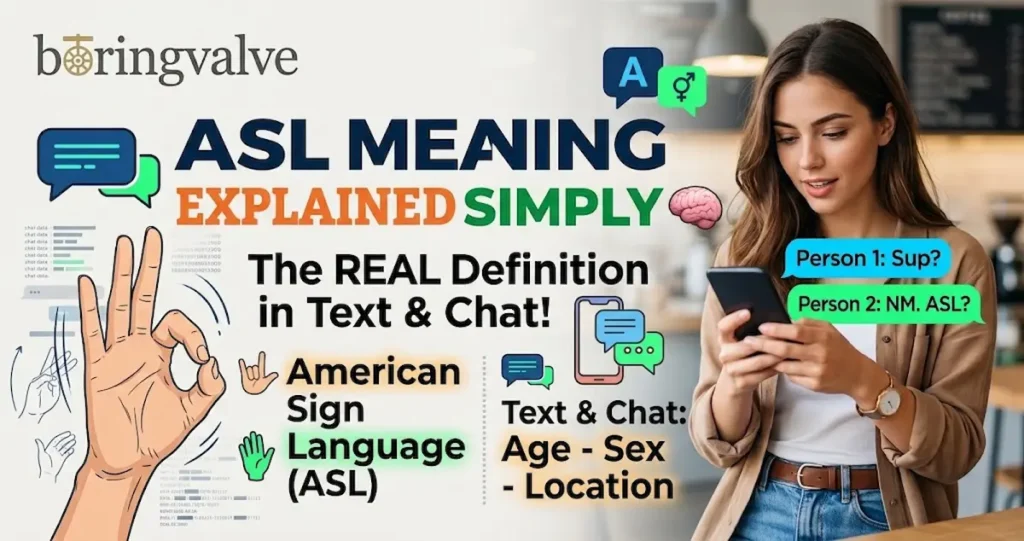
Think of ASL as a word with three completely separate lives depending on where you find it.
| Version of ASL | Simple Meaning | Where You’ll See It |
|---|---|---|
| Age, Sex, Location | A quick way to ask basic info about a stranger online | Chatrooms, Omegle-style apps, Discord, dating apps |
| As Hell | An intensifier that means very or extremely | TikTok captions, Instagram comments, casual texting |
| American Sign Language | A real, full language used by the Deaf community | Education, accessibility discussions, interpreting services |
The trick to understanding ASL fast is to look at what comes before and after it. If it is a standalone question at the start of a conversation with someone new, it almost always means age, sex, location. If it is tacked onto the end of a sentence describing a feeling or reaction, it means as hell. If the conversation is about deafness, interpreters, or accessibility, it means the actual sign language.
Origin of ASL Slang 📜
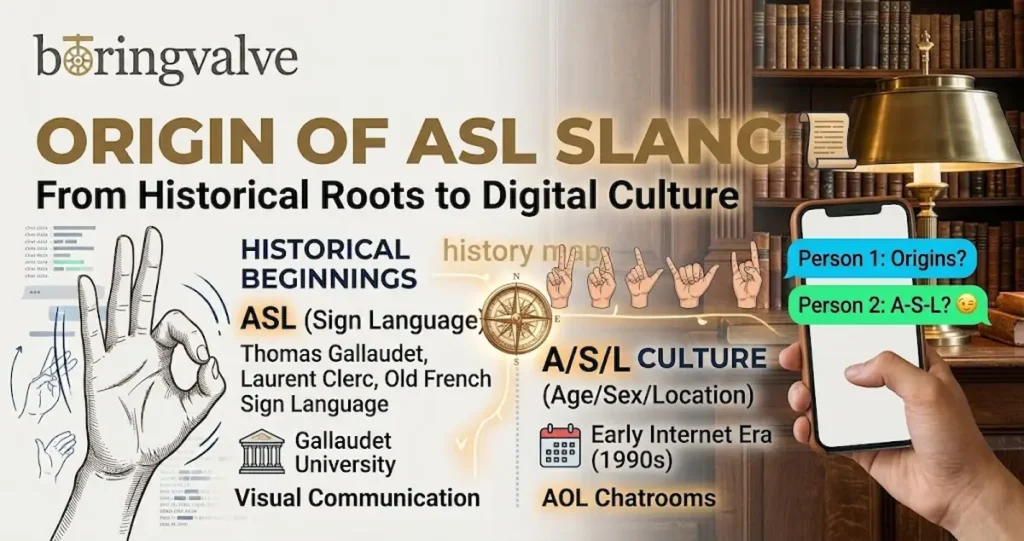
The age, sex, location version of ASL is one of the oldest pieces of internet slang still floating around today. It goes back to the late 1990s and early 2000s, when chatrooms like AOL Instant Messenger and early Yahoo chat rooms were the main way strangers met online.
Back then, there were no profile pictures, no bios, and no algorithms showing you who someone really was. So when a person joined a chatroom, the fastest way to get a sense of who they were talking to was to ask three quick questions bundled into one acronym. It caught on because it was efficient, and it spread across nearly every text-based chat platform of that era.
The as hell meaning of ASL developed much later and evolved naturally out of casual internet speech patterns, where phrases get shortened for speed and style. It became especially popular through short-form video platforms, where captions need to be punchy and quick to read.
American Sign Language, of course, predates internet slang entirely. It developed in the early 19th century and has its own grammar, structure, and history completely separate from anything related to texting culture.
Different Meanings of ASL 🔄
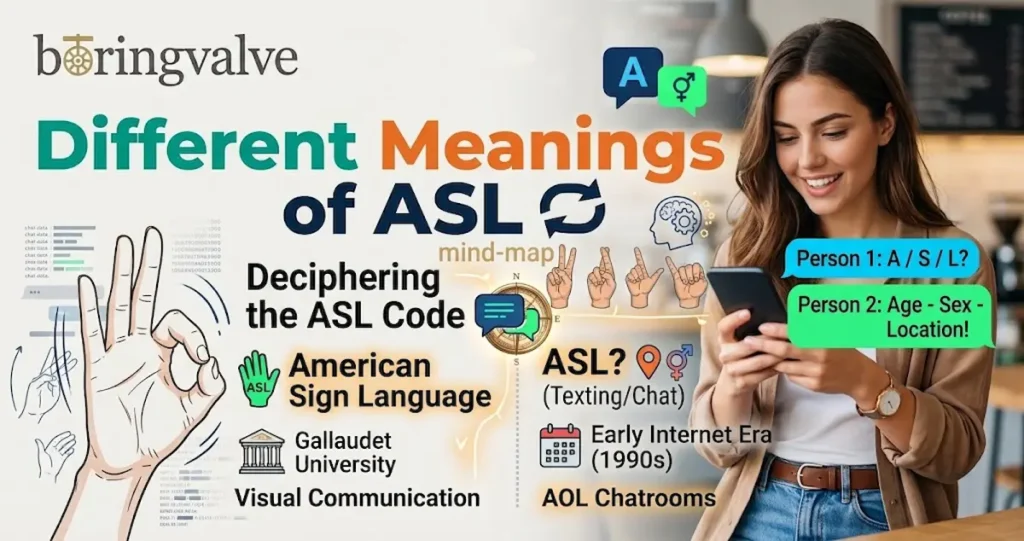
Because ASL shows up in so many different corners of the internet, it helps to see every possible meaning laid out clearly.
- Age, Sex, Location: The original and most well-known meaning, used to quickly learn basic details about a stranger.
- As Hell: A modern intensifier used to emphasize emotion, size, difficulty, or any other trait.
- American Sign Language: The formal, real-world sign language used by the Deaf community.
- All Systems Live: A more niche use seen occasionally in gaming, coding, or tech communities to confirm that something is fully operational.
The first two meanings dominate casual texting and social media, while the third is reserved for genuine conversations about language, accessibility, or education. The fourth meaning is rare and mostly limited to specific online communities, so context will make it obvious if that is what someone means.
ASL Usage Examples in Text ✍️
Seeing ASL used in real sentences makes the meaning click much faster than a plain definition. Here are a few natural examples for each version.
Age, Sex, Location:
- hey asl?
- new here, whats ur asl
- asl before we keep talking
As Hell:
- this homework is boring asl
- that concert was fun asl
- im tired asl right now
American Sign Language:
- Im learning ASL so I can talk to my deaf cousin
- Our school added an ASL class this semester
- The interpreter translated the speech into ASL
Notice how the age, sex, location version almost always shows up as a question near the beginning of a chat, while the as hell version shows up mid-sentence or at the end, attached to an adjective or feeling.
How to Reply to ASL 💬
If someone asks for your ASL and you are not sure how to respond, you have options that do not require handing over personal details.
- Answer only what feels safe. You can share your age range or general region without giving an exact city.
- Redirect the conversation. Something like why do you ask keeps the chat going without giving anything away.
- Decline politely. A simple I don’t share personal info online is a normal and accepted response in most chat spaces.
- Ignore it entirely. On anonymous platforms, you are never obligated to answer a stranger’s question.
There is no single correct reply. The right response depends entirely on the platform, who is asking, and how comfortable you feel with the conversation.
Is ASL Safe to Answer? 🔐
This is one of the most important parts of understanding ASL, especially for parents and younger users. When ASL is used to ask for age, sex, location, answering honestly means giving a stranger your exact age, gender, and general whereabouts, sometimes within seconds of starting a chat.
In most cases, people ask this out of simple curiosity or as an icebreaker. But it can also be used by people with bad intentions to figure out how old someone is or roughly where they live. That risk is exactly why many safety-focused resources recommend caution around this specific question.
A few practical safety habits:
- Never share your exact address, school name, or workplace, even if someone insists.
- Be extra cautious if a stranger asks ASL immediately, before any real conversation has happened.
- Talk to kids and teens about why this question can be risky and how to respond without oversharing.
- Trust your instincts. If a chat feels off after someone asks your ASL, it is okay to leave the conversation.
The as hell meaning of ASL and the American Sign Language meaning carry no privacy risk at all, since neither one is asking for personal information.
ASL vs Similar Slang ⚖️
ASL is not the only shorthand floating around chat apps. Here is how it compares to a few similar terms people often confuse it with.
| Slang | Meaning | Risk Level | Common Platform |
|---|---|---|---|
| ASL | Age, Sex, Location or As Hell | Medium (when used as A/S/L) | Chatrooms, TikTok, Discord |
| AF | As F, an intensifier similar to as hell | Low | Twitter, Instagram, texting |
| DM | Direct Message | Low | Instagram, Twitter, TikTok |
| PM | Private Message | Low | Forums, Discord, Reddit |
| STFU | An aggressive way to tell someone to stop talking | Low, but rude | Gaming chats, forums |
The biggest overlap in confusion is between ASL and AF, since both can function as intensifiers with almost identical meaning. The difference is mostly stylistic, with ASL being slightly more common in certain regions and communities.
ASL in Modern Social Media 📱
The way ASL is used today looks pretty different from its chatroom origins. On TikTok, ASL almost always means as hell, showing up in captions like funny asl or cold asl outside right now. Instagram comments follow the same pattern, using it to add punch to a short reaction.
On platforms built around meeting strangers, like certain Discord servers, older forums, or anonymous chat apps, the age, sex, location meaning is still alive, even if it feels a bit dated compared to modern dating app profiles that already display age and location automatically.
Because most apps now show a user’s age range, general location, or bio right on their profile, the original purpose of ASL has become less necessary. Even so, it survives as a fast way to open a conversation, especially in spaces where profiles are minimal or anonymous.
When Should You Use ASL? ⏰
Knowing when ASL fits naturally into a conversation helps you avoid sounding out of place or accidentally confusing someone.
- Use the as hell version when you want to add casual emphasis to a text or caption among friends.
- Use the age, sex, location version only in casual, anonymous chat settings where that kind of quick intro question is normal and expected.
- Use the full term American Sign Language in any formal, educational, or accessibility-related conversation, since abbreviating it there can come across as unclear or overly casual.
- Avoid using ASL of any kind in professional emails, school assignments, or workplace messaging, since it reads as informal internet shorthand.
Do’s and Don’ts of Using ASL ✅❌
A quick reference table makes it easy to remember how to use ASL appropriately.
| Do’s | Don’ts |
|---|---|
| Use as hell casually with friends for emphasis | Use ASL in formal writing or professional chats |
| Set boundaries if a stranger asks your age, sex, location | Share your exact address or full name when asked ASL |
| Spell out American Sign Language in serious discussions | Assume every ASL means the same thing without checking context |
| Teach younger users why the A/S/L question can be risky | Pressure anyone into answering personal questions online |
Why ASL Still Matters Today 🌍
Even with modern apps showing profile details automatically, ASL has not disappeared. It survives because language on the internet rarely dies completely, it just shifts meaning. The as hell version keeps ASL relevant among younger users who want a short, punchy way to express emotion. The age, sex, location version still pops up in anonymous or minimal-profile chat spaces. And the American Sign Language meaning remains permanently important as a real, living language used every day by millions of people.
Understanding all three meanings matters because misreading ASL can lead to awkward replies, or worse, oversharing personal information with a stranger who does not have good intentions. A little context awareness goes a long way toward using and responding to ASL correctly.
Related Slang You May Like 🔎
If ASL made sense to you, these related terms are worth knowing too.
- AF – as f, another intensifier similar to as hell
- NGL – not gonna lie, used before an honest opinion
- IRL – in real life, referring to offline situations
- SMH – shaking my head, used to express disbelief or disappointment
- PDA – used both for public displays of affection and, in older tech slang, personal digital assistant
FAQs
What is the main ASL meaning in text?
It most commonly means age, sex, location, used to quickly learn basic details about someone online.
Does ASL always mean Age, Sex, Location?
No, it can also mean as hell or American Sign Language depending on the context.
Is ASL outdated slang?
It is less common than before but still shows up in casual chats and social media captions.
Should I answer ASL?
Only if you feel comfortable, and never with information that puts your privacy at risk.
Is ASL safe for teens?
Not always, since answering honestly can reveal personal details to strangers, so caution is recommended.
Conclusion
ASL is one of those internet terms that proves context is everything. Depending on where you see it, it could be a stranger fishing for your age, sex, and location, a friend adding emphasis to how tired or excited they are, or someone talking about the real, structured language used by the Deaf community. Now that you know how to tell these apart, you can read any chat, comment, or caption with confidence and respond in whatever way feels right and safe for you.
