
Introduction
Have you ever received a message with FFS Meaning and wondered what it actually stands for? In today’s world of texting, social media, and online chats, internet slang evolves quickly, making it important to understand common abbreviations. FFS Meaning is one of the most widely used chat acronyms, appearing in conversations on WhatsApp, Instagram, Snapchat, TikTok, and many other platforms. Knowing the correct FFS Meaning helps you avoid confusion and understand the tone and context of online messages.
Whether you’re new to internet slang or simply want to stay updated with the latest digital language, this guide explains everything in simple words. At BoringValve.com, we break down FFS Meaning, its full form, common uses, examples, and when it’s appropriate to use it in 2026.
This complete guide breaks down everything you need to know about FFS meaning in text, its origin, emotional range, real-life usage examples, and much more. By the time you finish reading, you will use and respond to this popular slang term with full confidence.
What Does FFS Mean in Text? 🤔

FFS stands for “For F**k’s Sake.”
It is an informal text abbreviation used to express a sudden burst of frustration, impatience, annoyance, or disbelief. Think of it as the digital equivalent of throwing your hands up in the air and saying “Are you serious right now?!”
The three letters pack a strong emotional punch without requiring a long explanation. When someone types FFS, they are reacting to something irritating, repetitive, ridiculous, or deeply disappointing.
Here is a quick snapshot:
| Detail | Information |
| Full Form | For F**k’s Sake |
| Type | Internet slang / text abbreviation |
| Primary Emotion | Frustration, Annoyance, Impatience |
| Usage | Casual texting, social media, gaming, memes |
| Tone | Informal, emotional, sometimes humorous |
| Appropriate For | Friends, close contacts, informal platforms |
| Inappropriate For | Work emails, professional chats, formal writing |
FFS is sometimes written in lowercase as “ffs,” which usually feels lighter and more casual. In all caps, it reads as louder, more intense, and genuinely irritated.
Simple Explanation of FFS 🧠
If you want the simplest possible explanation, here it is:
FFS = “Come on!” or “Seriously?!” or “I cannot believe this.”
It is not a literal statement. Nobody using FFS is making a factual claim. They are releasing an emotional reaction to a situation that has pushed their patience to its limit.
Imagine you locked your keys in your car for the third time this week. You might text your friend: “FFS, I did it again.” That is not a sentence about information. That is an outburst of pure, relatable frustration.
This is what makes FFS so useful in digital communication: it says a lot with very little. In a world where people communicate fast, FFS delivers a complete emotional message in three characters.
It is worth noting that FFS sometimes has an alternative meaning in very lighthearted or humorous contexts. A small number of users playfully use it to stand for “For Fun’s Sake,” though this interpretation is far less common and specific to inside jokes among close friend groups.
Origin of FFS Slang 📜
The phrase “For F**k’s Sake” has existed in spoken British English for many decades. It developed as a stronger version of older, milder expressions like “For goodness’ sake” or “For heaven’s sake.” These phrases all share the same function: expressing exasperation at a situation.
The abbreviation FFS itself emerged in the early days of online chat culture. As internet forums, IRC channels, and early instant messaging platforms like MSN Messenger and AOL Instant Messenger became popular in the late 1990s and early 2000s, users needed ways to express strong emotions quickly without typing full sentences.
Gaming communities played a massive role in spreading FFS. In competitive multiplayer games, players frequently vented frustration in real time. Typing out the full phrase was too slow, so short abbreviations like FFS became standard vocabulary in gaming chat rooms.
A brief timeline of FFS evolution:
- Late 1990s: Appeared in early internet forums and IRC chat rooms
- Early 2000s: Spread through SMS texting and instant messaging platforms
- 2010s: Became mainstream across Twitter, Facebook, Reddit, and other social platforms
- 2020s: Fully embedded in everyday digital slang, meme culture, and Gen Z vocabulary
- 2026: Continues to dominate casual online communication globally
Today, FFS is more common among British and Australian internet users, though it is recognized globally across all English-speaking communities.
Is FFS Rude or Offensive? ⚠️
This depends entirely on context, relationship, and platform.
FFS is a mild profanity because the full phrase contains a swear word, even though the abbreviation hides it. That said, in casual online settings, most people do not treat FFS as a serious slur or personal attack.
When FFS can feel rude:

- When directed at a specific person in an aggressive tone
- When used in a professional or formal setting
- When the recipient does not know the sender well
- When typed in all caps repeatedly during an argument
When FFS feels casual or harmless:
- Between close friends venting about daily frustrations
- In gaming chats after a difficult loss
- In group chats reacting to funny or annoying situations
- On social media as a humorous caption or reaction comment
The key rule is this: know your audience. FFS is not appropriate for everyone. If you are unsure whether someone will take it in stride, it is safer to choose a milder alternative like “ugh,” “come on,” or “seriously?”
Common Situations Where FFS Is Used 😤
FFS shows up in very specific emotional moments. Here are the most common real-life situations where people reach for this abbreviation:
Technology Failures When Wi-Fi drops mid-meeting, a download fails, an app crashes, or a device freezes. Example: “FFS, the internet is down again.”
Repeated Mistakes When someone keeps making the same error, or when you catch yourself doing the same thing for the tenth time. Example: “FFS, I forgot to save my work again.”
Unexpected Changes When plans fall apart, an event gets cancelled, or something you counted on fails to happen. Example: “FFS, the delivery got pushed back by another week.”
Silly or Absurd Situations When something so ridiculous happens that frustration and laughter mix together. Example: “FFS, the dog ate my charger.”
Gaming Moments After a missed shot, an unexpected death, server lag, or a team loss. Example: “FFS, that was lag!”
Reacting to News or Trends On social media, when something goes viral that people find annoying or overwhelming. Example: “FFS, this trend is everywhere.”
FFS Usage Examples in Text Messages ✍️
Seeing FFS in real context makes it much easier to understand its tone and function. Here are detailed examples across different scenarios:
| Example Message | Situation | Emotional Tone |
| “FFS, my alarm didn’t go off.” | Running late | Frustrated |
| “ffs 😂 you forgot again?!” | Friend’s habit | Playful and teasing |
| “FFS!!! The server is down.” | Gaming issue | Intensely annoyed |
| “Oh FFS, seriously?” | Surprising news | Disbelief |
| “ffs I love this chaos 😂” | Fun situation | Ironic, humorous |
| “FFS, I already explained this.” | Repeated confusion | Impatient |
| “ffs why is everything so complicated” | General stress | Venting, exhausted |
| “FFS 😩 Monday morning again.” | Relatable life moment | Tired frustration |
Notice how the capitalization, punctuation, and emojis all shift the tone. Lowercase with a laughing emoji reads very differently from all caps with exclamation marks.
Different Emotional Tones of FFS 🎭
One of the most important things to understand about FFS is that it is not a one-dimensional term. It can carry several distinct emotional flavors depending on how it is written and in what context it appears.
Genuinely Angry FFS 😡 Written in all caps, often with multiple exclamation marks. The person is not joking. Something has truly pushed their limit. This version is the most intense and should be treated seriously.
Playful or Sarcastic FFS 😄 Often in lowercase with laughing or eye-roll emojis. The person is venting but is not actually upset. This is the most common use among close friends.
Exhausted or Defeated FFS 😩 Usually appears with emojis like 😩 or 😔. The person feels mentally drained or overwhelmed by a repeating problem rather than sharply annoyed.
Disbelieving FFS 😮 Paired with “seriously?” or “how?” The person is shocked and cannot process what just happened.
Dramatic or Exaggerated FFS 🎬 Used for comedic effect. The person is not actually frustrated but is performing frustration for entertainment, especially in social media captions or group chats.
Understanding which tone is being used helps you respond appropriately and avoid unnecessary tension.
FFS vs Similar Slang Terms ⚖️
FFS belongs to a wider family of emotional text abbreviations. Knowing how it compares to similar terms helps you understand each one’s unique flavor and when to use which.
| Slang | Full Form | Primary Emotion | Intensity |
| FFS | For F**k’s Sake | Frustration, Impatience | Medium-High |
| WTF | What The F**k | Shock, Disbelief | High |
| SMH | Shaking My Head | Disappointment, Disapproval | Medium |
| OMG | Oh My God | Surprise, Excitement | Medium |
| IDK | I Don’t Know | Uncertainty | Low |
| FML | F**k My Life | Self-directed frustration | High |
| IKR | I Know Right | Agreement, Validation | Low |
| TBH | To Be Honest | Sincerity, Candor | Neutral |
FFS and WTF are often confused. The key difference is that WTF focuses on surprise or confusion while FFS focuses on frustration or impatience. You might say WTF when something shocking happens, and FFS when something annoying keeps happening.
FFS and FML are also similar, but FML is self-directed while FFS can point outward at a situation or another person’s actions.
How to Respond When Someone Says FFS 💬
Receiving an FFS message can feel jarring if you are not sure what prompted it. Here is how to handle different scenarios smartly:
If they are frustrated at a situation (not at you): Empathize. Mirror their energy if you are close friends. Example: “Ugh, honestly same 😩” or “FFS is right, that’s ridiculous.”
If they are frustrated with you: Stay calm. Do not match the emotional intensity immediately. Acknowledge what happened without being defensive. Example: “Sorry about that, let me fix it.”
If it is clearly playful: Match the tone with humor. Example: “lmaooo FFS 😂 what happened now?”
If you are unsure of the tone: Ask calmly without escalating. Example: “Haha what’s going on?” or “You okay?”
If the situation is serious: Skip the jokes. Show genuine concern. Example: “That sounds super stressful, what happened?”
Here is a quick reference table:
| Their Tone | Your Best Response |
| Angry and upset | Empathize calmly |
| Playful and joking | Match humor, laugh along |
| Exhausted and venting | Offer support and listen |
| Directed at you | Acknowledge, apologize if needed |
| Posting on social media | React with an emoji or comment |
When You Should Avoid Using FFS 🚫
As fun and expressive as FFS can be in the right setting, there are plenty of situations where it is the wrong choice entirely.
Professional Settings Never use FFS in work emails, Slack messages to colleagues, client communications, LinkedIn messages, or any formal written document. Even if your workplace is casual, FFS crosses a line that could damage your professional reputation.
With People You Do Not Know Well FFS assumes a level of familiarity. Sending it to someone you just met, a distant acquaintance, or someone much older than you risks coming across as aggressive or disrespectful.
When Someone Is Already Upset If a conversation is already emotionally tense, dropping FFS can escalate the situation unnecessarily. Read the room before using any strong expressive slang.
In Academic Contexts School assignments, university essays, formal presentations, or any academic submission should never include FFS or similar informal slang.
With Audiences Who May Not Know Slang Not everyone is familiar with text abbreviations. Older family members, non-native English speakers, or people from formal backgrounds may misinterpret FFS as a technical term or feel offended by the implied language.
Can FFS Ever Be Positive? 🙂
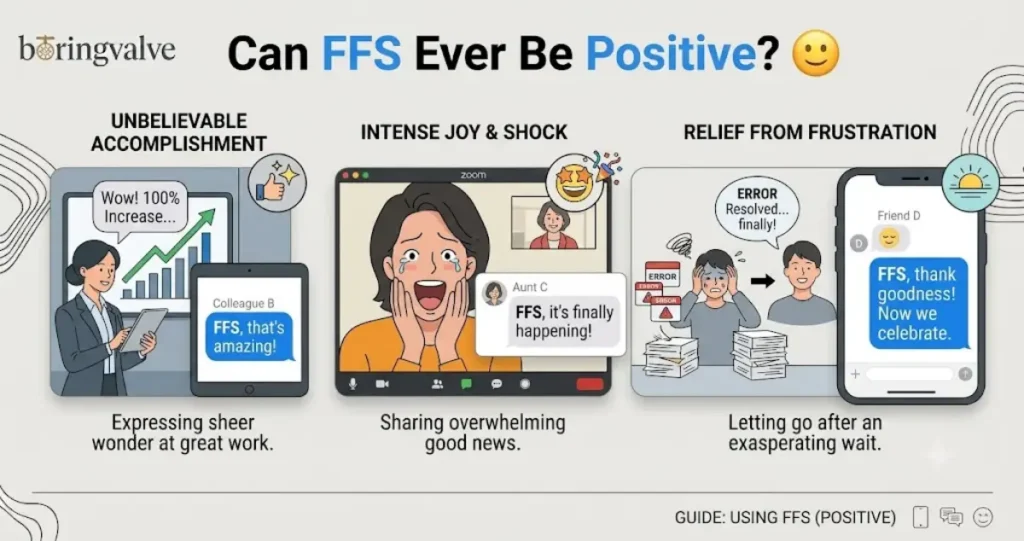
This might surprise you, but yes. In certain contexts, FFS carries a genuinely positive or affectionate energy.
When close friends use FFS in a playful, teasing way, it often signals warmth rather than hostility. “FFS, you’re always making me laugh 😂” is not an insult. It is the kind of expression that signals deep familiarity and comfort.
In meme culture, FFS is frequently used for comedic effect. A funny caption saying “FFS, not another Monday” is not really expressing serious anger. It is a relatable, humorous acknowledgment of a shared experience.
In gaming, “FFS that was a good play” (usually after a spectacularly bad or funny moment) can also carry ironic admiration.
So while FFS is not a compliment in the traditional sense, its tone is entirely context-dependent. Among people who are very close, it can actually signal trust and comfort, a relationship where both people are relaxed enough to be expressive without worrying about offending each other.
Why FFS Became Popular in Texting 📈
The rise of FFS in digital communication is not random. Several forces drove its widespread adoption:
Speed of Communication Texting and online chatting demand fast responses. Typing “For F**k’s Sake” takes too long. FFS communicates the same emotion instantly.
Character Limits and Screen Space Early SMS messaging had strict character limits. Abbreviations were not just convenient. They were necessary. FFS fit perfectly into that culture.
Emotional Shorthand Psychologists note that emotional abbreviations like FFS function as a release valve. They let people vent frustration in a way that feels less serious than saying the full phrase aloud or writing it in full.
Gaming Culture The online gaming community normalized fast emotional expressions in chat. FFS became standard vocabulary in multiplayer games, then spread into mainstream texting culture.
Social Media Amplification As platforms like Twitter, Reddit, TikTok, and Instagram grew, short emotional reactions became currency. FFS worked perfectly as a quick reaction in comments and captions.
Relatability and Humor FFS sounds funny when said aloud. It has a rhythm to it. People enjoy using it because it is emotionally satisfying and entertaining at the same time.
Related Slang You May Like 🔍
If FFS is part of your vocabulary, you will likely connect with these related internet slang terms that express similar or complementary emotions:
SMH (Shaking My Head) Used when you are disappointed or cannot believe what you are seeing. Less intense than FFS but often paired with it.
IKR (I Know Right) Perfect follow-up response when someone shares a FFS-worthy frustration. Shows you fully understand and agree.
NGL (Not Gonna Lie) Used when being honest about an emotion or reaction. “NGL, that was a FFS moment for me.”
TBH (To Be Honest) Similar to NGL, used for candid reactions. Pairs well with FFS in casual conversations.
FML (F**k My Life) Self-directed frustration, usually about personal misfortune. More self-deprecating than FFS.
OMG (Oh My God) Used for surprise, shock, or excitement. Can pair with FFS when something is both shocking and annoying.
LMAO (Laughing My A** Off) Often combined with FFS in playful texts to show something is both frustrating and funny.
WTF (What The F**k) Expresses shock or confusion. Close cousin to FFS but focuses on surprise rather than impatience.
These terms form the core vocabulary of casual digital communication in 2026 and beyond.
FAQs
Is FFS a swear word?
FFS contains implied profanity since it abbreviates a phrase with a swear word, so it is considered mild crude language rather than a direct swear word.
Can I use FFS with friends?
Yes, FFS is perfectly acceptable among close friends in casual texting and informal chat platforms.
Is FFS offensive?
It can be offensive in formal settings or when directed aggressively at someone, but among friends it is generally seen as harmless venting.
Does FFS always mean anger?
No, FFS can also express playful frustration, humor, sarcasm, exhaustion, or disbelief depending on the context and tone.
Is FFS common slang?
Yes, FFS is one of the most widely recognized text abbreviations used across social media, gaming, and casual messaging platforms worldwide.
Conclusion
FFS is more than just three letters. It is a complete emotional message. It signals frustration without requiring a paragraph of explanation. It vents annoyance without turning into a full argument. And in the right hands and the right context, it can even make people laugh.
Understanding FFS meaning in text means understanding that digital communication is emotional, fast, and context-sensitive. The same three letters can express genuine anger in one conversation and warm, teasing affection in another. The difference lies in how well you read the room.
Use FFS freely among friends who share your communication style. Keep it out of professional and formal settings. Pay attention to tone when you receive it. And when in doubt, a well-placed emoji goes a long way toward making sure your FFS lands exactly the way you intended.
Now that you know exactly what FFS means, how it evolved, and when to use it, you are fully equipped to navigate modern text slang like a pro in 2026 and beyond.
Read More article : 190+ Funny Leap Day Puns Guaranteed to Make You Jump with Laughter
