
Introducation
MHM Meaning is a popular internet expression that appears frequently in text messages, online chats, social media conversations, and digital communication. In most cases, “MHM” is used as a casual way of saying “yes,” showing agreement, acknowledgment, or understanding during a conversation. However, its exact meaning can vary depending on the context and tone of the discussion. As online slang continues to evolve in 2026, understanding terms like MHM can help you communicate more effectively and avoid confusion.
Whether you’re chatting with friends, replying to messages, or browsing social platforms, knowing how MHM is used is increasingly important. At BoringValve, we break down modern internet language and trending chat abbreviations to help readers stay informed and connected in today’s digital world.
This complete guide will walk you through everything you need to know about mhm in text messages, including its origin, context-based meanings, real usage examples, how to respond, and much more. By the time you finish reading, mhm will never confuse you again.
What Does MHM Mean in Text?
At its simplest, MHM means “yes,” “I agree,” or “I hear you.” It is a text-based version of the spoken sound “mm-hmm” that people make in real-life conversations to show they are listening or agreeing without interrupting.
When someone sends you mhm in a chat, they are essentially nodding through the screen. It is a soft, relaxed confirmation that does not carry the same energy as “YES!!!” but is warmer than a cold “k.”
Here is a quick breakdown of what mhm commonly signals:
- Agreement with what you just said
- Acknowledgment that they received your message
- Passive listening or following along
- A casual and non-confrontational response
The key thing to understand is that mhm is a contextual slang term. Its exact meaning shifts based on who sends it, when they send it, and how the conversation is flowing. A deeper understanding of its tone is what separates clear communication from misunderstood messages.
Simple Explanation of MHM
If you want the simplest possible answer: mhm means yes or I understand.
Think of it as the texting equivalent of a nod. When someone nods at you in person, they are telling you they are following along, they agree, or they simply acknowledge what you said. Mhm does the exact same thing in written form.
It is not a word in the traditional sense. It is a phonetic spelling of a natural human sound. That is also why it falls under a category linguists call a backchannel response, which is a signal that lets the speaker know the listener is engaged without taking over the conversation.
In everyday messaging, mhm is:
- Shorter than typing “I agree” or “understood”
- More conversational than a formal “yes”
- Less cold than “ok” or “k”
- More natural than “noted” or “got it”
This is why people love using it. It balances speed and warmth at the same time.
Origin of MHM
The story behind mhm goes back much further than smartphones or the internet. The sound “mm-hmm” has been part of spoken English for hundreds of years. People naturally produce this humming sound when they want to show agreement, attention, or acknowledgment during a conversation without interrupting the speaker.
Linguists officially classify this as a backchannel response, a communication tool that signals the listener is engaged and following along. The term “backchannel” was formally introduced by linguist Victor Yngve in 1970 to describe the secondary layer of feedback listeners provide while someone else speaks.
When instant messaging platforms became popular in the late 1990s and early 2000s, people began converting their spoken habits into typed text. Just as “laugh out loud” became “lol” and “be right back” became “brb,” the spoken “mm-hmm” transformed into the typed “mhm.”
Over time, as text slang evolution continued through the era of SMS, WhatsApp, Snapchat, and now TikTok comments, mhm became a universal piece of online slang recognized across age groups and platforms. Unlike trendy slang that fades within a year, mhm has lasted because it reflects a basic human communication habit rather than a passing pop culture moment.
Why People Use MHM in Texting
The rise of mhm in modern messaging is not accidental. It fills a specific gap in digital communication that other words cannot quite fill as naturally.
Here are the main reasons people use mhm in texting:
- It requires minimal effort during busy moments
- It keeps the conversation moving without adding pressure
- It mimics the natural flow of real spoken conversation
- It is non-confrontational and emotionally neutral
- It works as a low-effort reply that still shows presence
- It avoids sounding overly formal or robotic
People who are multitasking, half-distracted, or simply not in the mood to write long replies often reach for mhm because it does the job efficiently. It says “I am here and I acknowledge you” without demanding more from the sender.
In fast-paced chat environments like group chats, Discord servers, or Instagram DMs, mhm flows naturally because everyone understands its role as a conversational placeholder.
Different Meanings Based on Context
One of the most important things to understand about mhm is that its meaning is not fixed. It changes based on the situation, the relationship, the platform, and even the presence or absence of emojis.
Here is a breakdown of how mhm context meaning can vary:
| Context | Likely Meaning of MHM |
| Close friends chatting casually | Relaxed agreement or listening |
| Romantic partner conversation | Could be warm, or subtly distant |
| Busy parent replying mid-task | Passive acknowledgment, distracted |
| Emotional or serious discussion | May feel cold or dismissive |
| Confirming plans | Clear “yes, that works” |
| Reacting to uninteresting news | Low-energy agreement, disinterest |
| Sarcastic tone conversation | Could carry sarcasm or eye-roll energy |
As you can see, the same three letters carry very different weight depending on who sends them and under what circumstances. This is what makes mhm one of the most nuanced pieces of conversational slang in digital messaging today.
MHM in Romantic or Dating Chats
In dating conversations, mhm can feel flirty or warm when paired with follow-up messages or playful emojis. But without any additional context, it can also read as low interest or emotional distance. Always read the full conversation flow before drawing conclusions.
MHM in Professional Settings
In professional chats like Slack or Microsoft Teams, mhm can come across as curt, vague, or unprofessional. In formal work environments, it is better to use clear responses such as “understood,” “noted,” or “sounds good.”
MHM Usage Examples
Seeing mhm in real conversations helps make its meaning much clearer. Here are practical examples across different situations:
Example 1: Agreement Friend: “We should meet at 6 tonight, right?” You: “mhm, see you then.”
Example 2: Listening Partner: “I had such a long and exhausting day today.” You: “mhm, tell me what happened.”
Example 3: Casual Acknowledgment Sibling: “Mom said dinner is at 8.” You: “mhm, got it.”
Example 4: Disinterest (tone-dependent) Friend: “I just watched that documentary again.” You: “mhm.” (Short, no follow-up, suggests passive listening or low engagement)
Example 5: Sarcastic MHM Friend: “I promise I will be on time this time.” You: “mhm.” (Delivered with skepticism based on past behavior)
These examples show how much the surrounding words, punctuation, and follow-up messages shape the true tone interpretation of mhm in any conversation.
Is MHM Positive or Negative?
This is one of the most frequently asked questions about mhm in text, and the honest answer is: it depends entirely on context.
By default, mhm sits in a neutral emotional zone. It is not cold or harsh like “k.” It is not enthusiastic like “YES, absolutely!” It is calm, understated, and measured.
Here is how its emotional range works:
- Positive mhm: Used with warmth, follow-up messages, or affectionate emojis. Signals genuine agreement and attentiveness.
- Neutral mhm: A standard acknowledgment with no strong emotional charge. Just keeping the conversation going.
- Negative mhm: Sent alone with no follow-up, especially in emotional conversations. Can feel dismissive, indifferent, or passive-aggressive.
The safest interpretation in most casual conversations is neutral. Avoid reading too deeply into a single “mhm” unless the overall tone of the chat has already been cold or distant.
MHM vs Similar Text Expressions
Understanding how mhm compares to other short text abbreviations and slang helps you choose the right response in any situation.
| Expression | Meaning | Tone Compared to MHM |
| mhm | Yes, I agree, acknowledged | Neutral and conversational |
| mm-hmm | Same as mhm, slightly warmer | Slightly more expressive |
| hmm | Thinking, uncertain, processing | More hesitant than mhm |
| yeah | Yes, agreement | More energetic and direct |
| yep | Yes, definitive | Sharper and more certain |
| k / ok | Acknowledged | Colder and less warm |
| uh huh | Agreement, following along | Very similar to mhm |
| noted | Understood, received | Formal, professional tone |
As this comparison shows, mhm lives in a comfortable middle ground. It is warmer than “k” but less energetic than “yeah.” It feels the most natural in casual informal messaging where conversational flow matters more than precision.
How to Respond to MHM
If someone sends you an mhm and you are unsure how to reply, the best approach is to match the energy of the conversation.
Here are some practical tips for responding:
- If you want more engagement, gently ask a follow-up question: “Just mhm? Tell me what you think.”
- If the mhm was a clear “yes,” move the conversation forward: “Great, so we are confirmed for tomorrow then.”
- If it felt dismissive and bothered you, address it calmly: “You seem distracted, is everything okay?”
- If the conversation was casual and mhm fits naturally, just keep going as normal.
The most important thing is not to overthink a single “mhm.” In the vast majority of cases, it is simply a quick and natural acknowledgment with no deeper emotional meaning attached.
Can MHM Mean Disinterest?
Yes, in certain situations mhm can signal disinterest or passive engagement. When someone responds to a message they would normally react to with only “mhm” and no follow-up, it can feel like they are going through the motions rather than genuinely listening.
Signs that an mhm might indicate disinterest include:
- No follow-up message after the mhm
- Unusually long gap before the reply
- Sudden drop from previously engaged conversation
- Lack of emojis or tone markers in a usually expressive chat
However, it is important not to jump to conclusions. Many people type mhm simply because they are busy, tired, or replying quickly while doing something else. Passive listening in text is not always a sign of emotional withdrawal. Give the person the benefit of the doubt before reading too much into it.
Using MHM with Emojis
One of the most effective ways to remove ambiguity from mhm is to pair it with an emoji. The emoji completely shifts the emotional tone and makes the intent crystal clear.
Here is how mhm with emojis changes meaning:
- “mhm :)” or “mhm haha” signals friendly, warm agreement
- “mhm…” signals hesitation or subtle skepticism
- “MHM!!” signals enthusiastic agreement with added energy
- “mhm” with no emoji in an emotional conversation may feel flat or distant
Using expressive digital communication tools like emojis alongside short replies is a smart habit that prevents misreading. When in doubt, add a small smiley or a thumbs up to clarify your tone and keep the conversation feeling warm.
Do’s and Don’ts of Using MHM
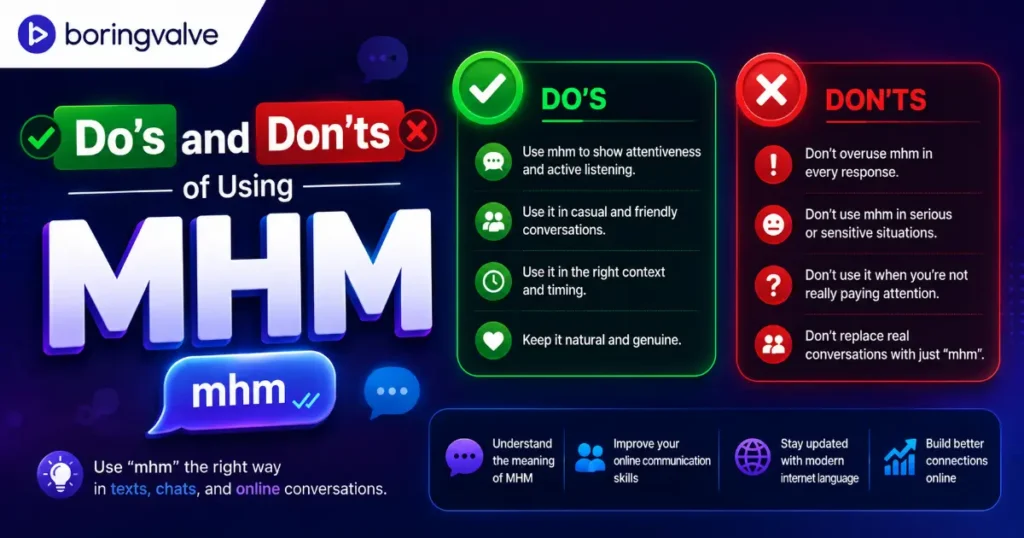
Knowing when to use mhm and when to avoid it can seriously improve your communication. Here is a practical guide:
Do’s
- Use mhm in casual conversations with close friends or family
- Use it to quickly acknowledge a message when you are in the middle of something
- Pair it with an emoji when you want to clarify your tone
- Use it as a natural follow-up to keep light conversations flowing
- Use it when confirming simple plans or agreements
Don’ts
- Avoid using mhm in formal or professional communication
- Do not use it as a response to emotional or serious messages where the other person needs real engagement
- Avoid overusing mhm in a single conversation as it can start to feel dismissive
- Do not use it as a substitute for a genuine answer when someone asks you a direct question
- Avoid sending a lone mhm when someone shares exciting or important news
Why Understanding MHM Matters
In an age where most of our communication happens through screens, being able to read short text expressions accurately is a genuine communication skill. Misreading a mhm as cold when it was meant warmly, or missing real disinterest because you assumed mhm always means yes, creates unnecessary tension and confusion.
Emotional intelligence in texting means paying attention to the full context of a conversation, not just a single word or phrase. Understanding tools like mhm helps you:
- Respond more appropriately to the tone of a conversation
- Avoid unnecessary misunderstandings with people you care about
- Communicate more naturally and confidently in digital spaces
- Build stronger relationships through better online communication skills
As text-based communication continues to dominate how people connect in 2026 and beyond, fluency in digital slang literacy is not just helpful but genuinely important for everyday social and professional interactions.
Related Slang You May Like
If you found this guide helpful, here are other popular text slang terms that follow a similar pattern of short, tone-dependent expressions worth knowing:
- hmm – Thinking or uncertain, similar hesitation to a quiet mhm
- lol – Laugh out loud, often used to soften tone or express amusement
- smh – Shaking my head, used to show disbelief or mild disappointment
- imo / imho – In my opinion / in my humble opinion
- ngl – Not gonna lie, used before an honest or blunt statement
- imo – In my opinion, a qualifier before sharing a perspective
- brb – Be right back, pausing the conversation temporarily
- idk – I don’t know, a quick expression of uncertainty
- ttyl – Talk to you later, a casual sign-off
- istg – I swear to God, used for emphasis or frustration
FAQs
What does MHM mean in a text from a girl?
It usually means “yes” or “I understand” used as a soft, casual agreement.
Is MHM the same as yes?
Yes, in most contexts mhm is a casual, conversational version of yes.
What does MHM mean on Snapchat?
On Snapchat it carries the same meaning: agreement, acknowledgment, or casual listening.
Can MHM be sarcastic?
Yes, when used with certain tones or in a skeptical context, mhm can express sarcasm.
What is the full form of MHM?
MHM does not have a formal full form; it is a phonetic spelling of the spoken sound “mm-hmm.”
Is MHM rude?
Not inherently, but in emotional or serious conversations it can feel dismissive without follow-up.
Should I use MHM in professional messages?
No, mhm is informal and can appear curt or unprofessional in workplace settings.
What does double MHM mean?
“Mhm mhm” usually emphasizes stronger agreement or enthusiastic acknowledgment.
What does MHM mean from a guy?
From a guy it typically means agreement or that he is listening, same as any other sender.
How do I respond to MHM?
Match the energy of the conversation or ask a follow-up if you want more engagement.
Conclusion
Understanding the mhm meaning in text is simpler than it first appears once you know how to read context. At its core, mhm is a friendly, natural acknowledgment rooted in real human speech patterns. It means yes, I agree, or I am listening depending on the situation and the relationship behind the message.
What makes mhm fascinating is that it carries real emotional weight in digital conversations without using a single traditional word. It is a phonetic sound turned into a texting habit, and in 2026, it is one of the most widely used short expressions in casual online communication.
The next time you receive an mhm, read the full conversation before reacting. And the next time you want to send one, think about whether a quick emoji alongside it might make your tone even clearer. Great communication, even in its shortest forms, always comes down to clarity and intention.
