
Introduction
Have you ever wondered what AI Meaning actually is and why everyone is talking about it? Artificial Intelligence, commonly known as AI, is transforming the way we work, communicate, learn, and solve problems. Understanding AI Meaning is essential in today’s technology-driven world because AI is now part of everyday life, from virtual assistants and chatbots to self-driving cars and smart recommendations.
As technology continues to evolve, more people are searching for AI Meaning to better understand how it works and why it matters. Whether you’re a student, professional, or complete beginner, learning about AI can help you stay informed about the future of innovation. At BoringValve.com, this beginner-friendly guide explains AI Meaning in simple terms and explores its real-world applications in 2026.
This guide breaks down everything you need to know about AI, from its meaning and history to how it works, its types, real-world uses, and what the future holds. No jargon, no confusion. Just clear, honest answers.
What is AI Meaning? 🤖
AI meaning in simple terms is: machines or computer systems that are designed to perform tasks that normally require human intelligence.
The full form of AI is Artificial Intelligence, where:
- Artificial = Created or made by humans
- Intelligence = The ability to learn, reason, and solve problems
So when we combine both words, AI means a machine-powered system that can think, learn, adapt, and make decisions much like a human brain does, but at a much faster speed and scale.
Here is a simple definition for featured snippets:
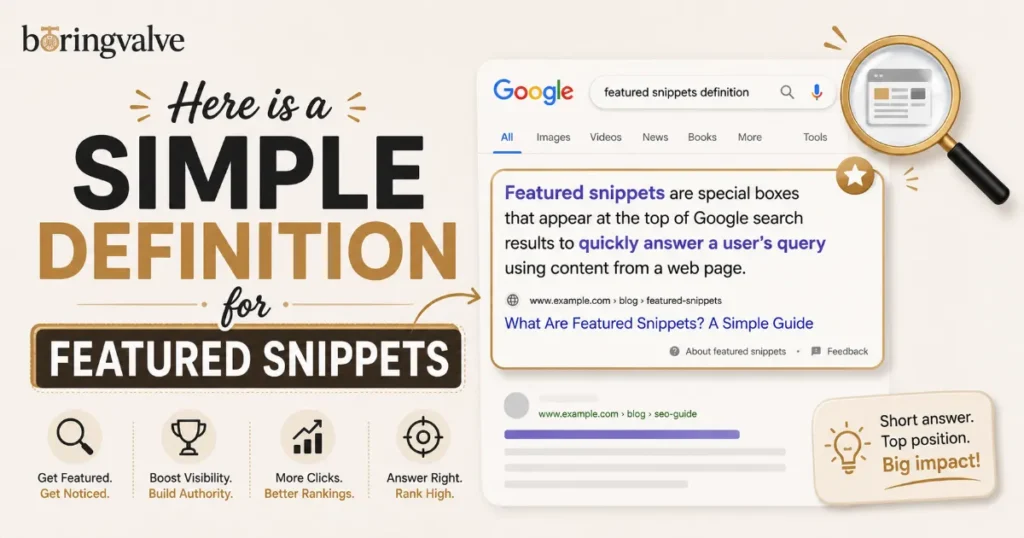
AI (Artificial Intelligence) is a branch of computer science that enables machines to mimic human cognitive functions such as learning, reasoning, problem-solving, language understanding, and perception.
In 2026, AI is not just one technology. It is an entire ecosystem of tools, systems, and algorithms that power everything from voice assistants and self-driving cars to medical diagnosis and financial forecasting.
Key concepts closely tied to AI meaning include:
- Machine learning (ML): How AI learns from data without being explicitly programmed
- Deep learning: A more advanced form of ML using neural networks
- Natural language processing (NLP): How AI understands and generates human language
- Computer vision: How AI interprets and processes images and videos
- Generative AI: AI that creates new content like text, images, audio, and code
Understanding these core AI concepts is the first step toward understanding the bigger picture.
Origin / History of AI 🕰️
The idea of intelligent machines is not new. Humans have dreamed of creating thinking machines for centuries. But the formal birth of Artificial Intelligence as a scientific field is more recent.
The foundations were laid in the early 20th century. In 1950, British mathematician Alan Turing published a paper titled “Computing Machinery and Intelligence,” where he asked the famous question: “Can machines think?” He proposed the Turing Test as a way to measure machine intelligence. This was the spark that ignited decades of research.
In 1956, a group of researchers gathered at Dartmouth College in the United States. This event, known as the Dartmouth Conference, is widely considered the official birth of AI as a discipline. It was here that the term “Artificial Intelligence” was first used.
Key Milestones in AI Development
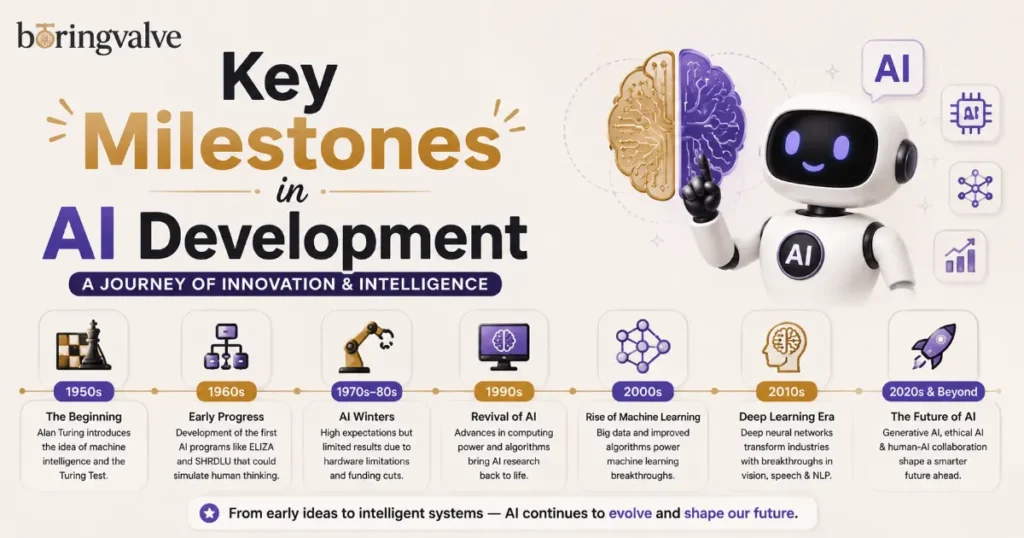
| Year | Milestone | Significance |
| 1950 | Alan Turing proposes the Turing Test | First framework to measure machine intelligence |
| 1956 | Dartmouth Conference | AI officially recognized as a field |
| 1966 | ELIZA chatbot created at MIT | First natural language processing program |
| 1980s | Expert Systems developed | AI used to mimic human expertise in specific domains |
| 1997 | IBM Deep Blue defeats chess champion Kasparov | Proved AI could outperform humans in complex tasks |
| 2011 | IBM Watson wins Jeopardy | Demonstrated advanced natural language understanding |
| 2012 | AlexNet revolutionizes image recognition | Launch of the deep learning era |
| 2016 | Google DeepMind AlphaGo defeats world champion | AI masters one of the most complex board games |
| 2022 | ChatGPT launched by OpenAI | Generative AI enters mainstream use |
| 2025-2026 | Frontier models like GPT-5, Claude Opus, Gemini 3 | Agentic AI and multimodal capabilities become standard |
The journey from Turing’s theoretical paper to today’s large language models (LLMs) spans over 70 years of breakthroughs, failures, and rediscoveries. What we call the AI revolution today is built on all of those stepping stones.
How Does AI Work? ⚙️
One of the most common questions beginners ask is: how does AI actually work? The answer involves a few key building blocks working together.
At its core, AI works by processing large amounts of training data, identifying patterns within that data, and then using those patterns to make predictions or decisions on new, unseen inputs.
Think of it this way. When a baby learns to recognize a cat, they see hundreds of cats, hear the word “cat,” and slowly build a mental model of what a cat looks and sounds like. AI learns in a very similar way, just with data instead of real-life experiences.
Here are the main components of how AI works:
Data Collection and Preparation AI systems need data to learn. This could be images, text, audio, numbers, or any other form of information. The more high-quality data an AI has, the better it learns.
Training with Algorithms The AI is trained using algorithms, which are sets of rules or mathematical functions. During training, the model looks at thousands or millions of examples and adjusts its internal parameters to get better at predicting the correct answer.
Neural Networks and Deep Learning Modern AI relies heavily on artificial neural networks, structures inspired by the human brain. These networks contain layers of interconnected nodes that process information step by step. When there are many layers, it is called deep learning, and this is what powers tools like ChatGPT, image generators, and voice assistants.
Learning Methods AI can learn in several ways:
- Supervised learning: The model is trained on labeled data (for example, photos labeled as cats or dogs)
- Unsupervised learning: The model finds hidden patterns in unlabeled data on its own
- Reinforcement learning: The model learns through trial and error, receiving rewards for correct actions
Inference and Output Once trained, the AI applies what it has learned to new situations. This is called inference. For example, a trained image recognition model can look at a photo it has never seen and correctly identify what is in it.
In 2026, AI systems also use techniques like transformers (the technology behind large language models), diffusion models (used in image generation), and retrieval-augmented generation (RAG) to improve accuracy and relevance in their outputs.
Types of AI 🧩
Not all AI is the same. Scientists and researchers classify AI into three main types based on capability and scope.
1. Narrow AI
Narrow AI, also known as Weak AI or Artificial Narrow Intelligence (ANI), is the only type of AI that actually exists today. It is designed to perform one specific task or a limited set of related tasks with high efficiency.
Narrow AI is incredibly powerful within its domain but cannot operate outside of it. A voice assistant like Siri or Alexa is excellent at understanding voice commands, but it cannot diagnose a disease or drive a car without being specifically programmed to do so.
Common examples of Narrow AI include:
- Spam filters in email
- Product recommendations on Amazon or Netflix
- Face recognition on smartphones
- Self-driving vehicle features
- AI chatbots in customer service
- Machine translation tools like Google Translate
In 2026, the most advanced Narrow AI systems, such as GPT-5, Claude Opus 4, and Gemini 3, can perform a wide range of language tasks. But they are still considered narrow because they are not truly conscious or self-aware.
2. General AI
General AI, also known as Strong AI or Artificial General Intelligence (AGI), refers to a hypothetical machine that can perform any intellectual task that a human can do. It would be capable of switching between completely different types of problems, such as writing a poem, solving a math problem, diagnosing an illness, and learning a new language, all with equal ability.
As of 2026, AGI does not yet exist. It remains one of the most ambitious goals in the AI research community. Some researchers believe we are decades away from achieving it. Others argue it may never be fully realized in the way science fiction portrays it.
What makes AGI so challenging is that it requires not just information processing but also true common sense reasoning, emotional understanding, and contextual awareness in open-ended environments.
3. Super AI
Super AI, or Artificial Superintelligence (ASI), is a theoretical concept describing an AI that surpasses human intelligence in every possible domain, including creativity, problem-solving, social intelligence, and scientific discovery.
Super AI is still purely in the realm of theory and philosophy. It is a concept that inspires both excitement and serious concern among AI researchers, ethicists, and world leaders. Thinkers like Nick Bostrom have written extensively about the potential risks and implications of superintelligent AI on humanity.
For now, Super AI belongs to the future, but understanding it helps us think carefully about where AI development is headed.
| Type | Also Known As | Status | Examples |
| Narrow AI | Weak AI / ANI | Exists today | ChatGPT, Siri, Alexa, image recognition |
| General AI | Strong AI / AGI | Under research, not yet achieved | Theoretical |
| Super AI | ASI | Theoretical only | Hypothetical future systems |
Real-Life Examples of AI 🌍
AI is not something you will encounter only in tech labs or science fiction movies. It is already woven into your everyday life in ways you may not even realize.
Here are some of the most common real-world examples of AI applications across different sectors:
Healthcare and Medicine AI systems analyze medical images such as X-rays and MRI scans to detect diseases like cancer, sometimes even before trained doctors can. Predictive analytics powered by AI help hospitals anticipate patient readmissions. Drug discovery processes that used to take years are now being accelerated using AI-driven molecular simulations.
E-Commerce and Retail When you browse Amazon or Flipkart and see a “You may also like” section, that is a recommendation engine powered by AI. Dynamic pricing algorithms that adjust flight and hotel prices in real time are also AI-driven. Chatbots handle customer inquiries around the clock without human agents.
Finance and Banking Banks use AI for fraud detection, spotting unusual patterns in transactions within milliseconds. Credit scoring models powered by machine learning assess loan applications more accurately. Algorithmic trading systems make thousands of financial decisions per second based on market data.
Transportation and Mobility AI powers autonomous vehicle technology, helping cars sense their surroundings, identify obstacles, and make split-second driving decisions. Ride-hailing apps like Uber use AI for route optimization and dynamic pricing.
Education AI-powered platforms adapt learning content to each student’s pace and style, a concept known as personalized learning. Automated grading tools save teachers hours of manual work. Language learning apps like Duolingo use AI to tailor exercises based on user performance.
Entertainment and Media Netflix, YouTube, and Spotify all use content recommendation algorithms to keep users engaged. AI is also being used to generate music, write scripts, and create visual art.
Smart Assistants Voice-based AI assistants like Google Assistant, Apple Siri, Amazon Alexa, and Samsung Bixby respond to voice commands, set reminders, answer questions, and control smart home devices.
Benefits of AI 🌟
AI brings with it a wide range of advantages that are already making life easier, safer, and more efficient for millions of people.
Automation of Repetitive Tasks AI excels at handling high-volume, repetitive tasks without fatigue or loss of accuracy. Data entry, invoice processing, inventory management, and quality control in manufacturing are just a few examples where intelligent automation saves enormous time and resources.
Improved Accuracy and Fewer Errors Unlike humans, AI systems do not get tired, distracted, or emotional. In critical fields like medicine, aviation, and engineering, this results in significantly fewer errors. AI-assisted diagnosis has shown higher accuracy than manual methods in several clinical studies.
Faster Decision-Making AI can process and analyze massive datasets in seconds. This speed allows businesses to make data-driven decisions in real time, whether it is adjusting supply chains, targeting marketing campaigns, or identifying security threats.
Personalization at Scale AI enables companies to deliver highly personalized experiences to millions of users simultaneously. From personalized health plans and learning paths to customized shopping experiences, AI makes tailored interactions possible at a scale no human team could manage.
Accessibility and Inclusion AI-powered tools like real-time speech-to-text transcription, language translation, and screen readers are helping people with disabilities participate more fully in society and the workforce.
Scientific Research and Innovation AI is accelerating discoveries in areas like climate modeling, genomics, material science, and astronomy. Research that once took decades can now be completed in a fraction of the time thanks to AI-assisted data analysis.
Disadvantages of AI ⚠️
Despite its many benefits, AI comes with real challenges and risks that society must address thoughtfully.
Job Displacement and Workforce Disruption Automation powered by AI is replacing certain categories of jobs, particularly those involving routine, rule-based tasks. While AI creates new roles, the transition can be painful for workers whose skills become obsolete. Reskilling and upskilling are becoming critical needs worldwide.
Bias and Fairness Issues AI systems learn from historical data, and if that data contains biases, the AI will replicate and even amplify those biases. This has led to documented cases of algorithmic bias in hiring tools, loan approval systems, and criminal justice applications.
Privacy and Surveillance Concerns AI-powered facial recognition, behavioral tracking, and data profiling raise serious questions about individual privacy. Governments and corporations with access to sophisticated AI tools have unprecedented surveillance capabilities.
High Costs of Development and Maintenance Building and maintaining advanced AI systems requires significant investment in computing infrastructure, data, and specialized talent. This creates a gap between large organizations and smaller businesses or developing nations.
Lack of Transparency (The Black Box Problem) Many advanced AI models, particularly deep learning systems, are difficult to interpret. Even their creators sometimes cannot fully explain why a model made a specific decision. This lack of explainability is a serious concern in high-stakes applications like healthcare or criminal justice.
Security and Misuse Risks AI can be weaponized. Deepfakes, AI-generated misinformation, automated cyberattacks, and the potential use of AI in warfare are serious threats that require robust governance frameworks.
Regulatory Challenges With the EU AI Act now in active enforcement in 2026, organizations operating AI in high-risk categories such as employment, education, and financial services face significant compliance obligations and the risk of major fines.
AI in Daily Life 💡
You interact with AI more than you probably realize. Here is a snapshot of how AI touches nearly every part of your typical day.
Morning Routine Your smartphone alarm uses AI to track your sleep patterns and wake you at the optimal time. Your news feed is curated by content personalization algorithms. Asking a voice assistant the weather forecast taps into AI-powered natural language processing.
Work and Productivity Email spam filters powered by AI keep your inbox manageable. Tools like Grammarly use NLP to improve your writing in real time. Video conferencing platforms use AI for background noise cancellation and auto-generated captions.
Shopping and Finance Your credit card company uses AI to flag suspicious transactions the moment they happen. E-commerce platforms recommend products based on your browsing and purchase history. Insurance companies use AI to personalize premiums and detect fraudulent claims.
Health and Wellness Fitness apps analyze your workout data to suggest personalized plans. Telehealth platforms use AI to assist doctors in reviewing symptoms and medical records. Mental health apps use conversational AI to provide guided support.
Navigation and Transport GPS apps like Google Maps use AI to predict traffic and suggest the fastest routes in real time. Ride-sharing platforms optimize driver-rider matching and pricing using AI. Many modern cars include AI-driven safety features like lane assistance and automatic emergency braking.
AI vs Human Intelligence 🧠
Understanding the difference between artificial and human intelligence helps clarify what AI can and cannot do.
| Feature | AI | Human Intelligence |
| Speed of processing | Extremely fast | Slower but contextual |
| Emotions and empathy | None (currently) | Core to decision-making |
| Creativity and intuition | Limited, improving | Natural and fluid |
| Learning from data | Requires massive datasets | Learns from few examples |
| Common sense reasoning | Weak | Strong and instinctive |
| Adaptability to new situations | Limited without retraining | Highly flexible |
| Physical experience | None | Grounded in embodied experience |
| Self-awareness | No | Yes |
| Energy efficiency | Very high energy consumption | Remarkably efficient |
| Consistency | Highly consistent | Subject to fatigue and emotion |
The key takeaway is that AI and human intelligence are not in competition. They are complementary. AI handles tasks that require speed, scale, and data processing. Humans excel at tasks that require empathy, ethical judgment, creativity, and navigating complex social contexts.
The most powerful outcomes in 2026 come from human-AI collaboration, where each amplifies the strengths of the other.
Future of AI 🔮
The pace of AI development in 2026 shows no signs of slowing. Several major trends are shaping where AI is headed in the near and long term.
Agentic AI One of the biggest shifts happening right now is the move from AI that responds to AI that acts. AI agents can now plan, reason, use tools, and complete multi-step tasks with minimal human input. This includes scheduling meetings, conducting research, writing code, and managing complex workflows autonomously.
Multimodal AI Modern AI systems can now simultaneously process text, images, audio, and video. This multimodal capability is enabling more natural human-computer interactions and opening new possibilities in fields like education, medicine, and creative industries.
AI in Scientific Discovery AI is being used to accelerate breakthroughs in protein folding, climate modeling, battery chemistry, and space exploration. Tools like AlphaFold from Google DeepMind have already transformed how scientists understand biological systems.
Small Language Models (SLMs) While large models dominate headlines, smaller and more efficient models are gaining traction. SLMs can run on personal devices without internet connectivity, making AI more accessible and privacy-friendly.
Regulation and Governance Governments worldwide are introducing AI regulations. The EU AI Act is the most comprehensive framework in force. Expect more global coordination on AI safety standards, transparency requirements, and ethical guidelines as the technology matures.
Toward AGI The question of whether and when Artificial General Intelligence will be achieved remains hotly debated. Most experts believe we are still years or decades away, but the rapid pace of progress keeps the conversation urgent.
What is clear is that AI will continue to transform every industry, reshape job markets, and raise profound questions about the kind of future humanity wants to build.
Common Misconceptions About AI ❌
There are many myths and misunderstandings about AI that are worth clearing up, especially for beginners.
Misconception 1: AI is the same as robots Most AI exists entirely as software. Voice assistants, recommendation engines, and fraud detection systems are all forms of AI with no physical form whatsoever. While some robots do use AI to navigate and make decisions, AI itself is not inherently robotic.
Misconception 2: AI understands and thinks like a human AI models process statistical patterns in data. They do not truly understand language, images, or situations the way humans do. When ChatGPT answers a question, it is generating statistically likely sequences of words based on its training, not genuinely reasoning from understanding.
Misconception 3: AI is always accurate and unbiased AI systems can and do make mistakes. They reflect the biases present in their training data and can produce outputs that are incorrect, misleading, or unfair. This is why human oversight remains essential.
Misconception 4: AI will immediately replace all human jobs While AI is automating certain tasks and roles, it is also creating new categories of work. Historically, major technology shifts have eliminated some jobs while generating others. AI is more likely to transform how people work than to eliminate the need for human workers entirely.
Misconception 5: AI is dangerous on its own AI systems do not have intentions, ambitions, or desires. The risks associated with AI come from how they are designed, deployed, and governed by humans. Responsible AI development, ethical guidelines, and strong regulation are the keys to managing those risks.
Misconception 6: You need to be a tech expert to use AI In 2026, AI tools are more accessible and user-friendly than ever before. Tools like ChatGPT, Canva AI, Grammarly, and Google Gemini are designed for everyday users, not just engineers or data scientists. AI literacy is now a skill for everyone.
FAQs:
What is AI in simple words?
AI stands for Artificial Intelligence, which means machines or software that can learn, reason, and make decisions the way humans do.
Where is AI used?
AI is used in healthcare, finance, education, transportation, e-commerce, entertainment, customer service, and virtually every other major industry today.
Is AI dangerous?
AI itself is not inherently dangerous, but its misuse or poor governance can create risks including job displacement, privacy violations, bias, and security threats.
Can AI replace humans?
AI can automate specific tasks but cannot fully replace human creativity, empathy, ethical judgment, or adaptability, making human-AI collaboration more likely than full replacement.
Conclusion:
Understanding what AI means is no longer optional. In 2026, artificial intelligence has moved from the pages of science fiction into the center of daily life, business, and global policy. From the machine learning models that power your streaming recommendations to the neural networks that help doctors detect cancer earlier, AI is working behind the scenes in ways both visible and invisible.
This guide has walked you through everything from the basic AI definition and its fascinating history to how it works, the different types of AI, its real-world applications, benefits, challenges, and what lies ahead. The goal was never to overwhelm you with technical details but to give you a clear, honest, and complete picture of this technology that is reshaping our world.
The most important thing to take away is this: AI is a tool. Like all powerful tools, its impact depends entirely on how thoughtfully and responsibly it is used. The more informed you are about AI meaning, the better equipped you will be to navigate, benefit from, and help shape the AI-powered world around you.
Stay curious, keep learning, and do not be afraid of AI. It is here to help.
